Candy at the cash register – a risk factor for obesity?
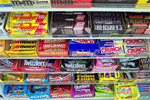
Placing confectionery near the cash register is widely acknowledged to encourage spur of the moment purchases. A recent article in the New England Journal of Medicine claims that this product placement is a risk factor for obesity and chronic disease.
The article authors, Deborah Cohen and Susan Babey, believe that placement of foods in prominent locations increases the rate at which they’re purchased; purchase leads to consumption; and consumption of foods high in sugar, fat, and salt increases the risks of chronic diseases. Because of this chain of causation, the authors argue that the prominent placement of foods associated with chronic diseases should be treated as a risk factor for those diseases. And in light of the public health implications, steps should be taken to mitigate that risk.
Even if many people acknowledge that food placement can attract attention, they think that those who respond to impulse marketing simply lack self-control and should learn how to resist such marketing strategies. Yet research using eye tracking equipment has shown that the attention drawn by special displays, particularly on the ends of aisles, has more to do with the display characteristics than with the goals and capacities of individual people. Something about the arrangements and the edges of such displays compels a response. Marketers carefully pretest their promotional displays and often use the same sophisticated eye-tracking equipment to make sure that customers cannot ignore them. People lack the capacity to fully control their eye gaze, and what they look at the longest is the strongest predictor of what they will buy. Furthermore, most purchasing decisions are made very quickly and automatically without substantial cognitive input, usually in less than a second. And choices of foods high in fat and sugar are made more quickly than are choices of healthful foods such as fruits and vegetables. For all these reasons, promotional displays of low-nutrient foods are both particularly influential and difficult to resist.
Moreover, most people don’t even recognise that the placement of products in retail outlets influences their purchases or their eating behavior. In fact, they typically deny the existence of contextual influences, even when those influences are pointed out to them. Yet multiple controlled studies as well as market research have shown that placement matters.
Even when people are consciously trying to make healthful choices, their ability to resist palatable foods in convenient locations wanes when they are distracted, are under stress, are tired, or have just made other decisions that deplete their cognitive capacity. Once cognitive capacity is depleted, automatic processing that relies on heuristics and other shortcuts dominates, and under these circumstances people are more likely to choose foods high in sugar and fat. Often people regret their purchases of candies, sodas, chips, and cookies. They may recognise that they were impulsive but have no way of avoiding being confronted with these goods, even if they initially went into the store seeking other products.
Although placement is a factor that is right in front of our noses, we should consider treating it as a hidden risk factor, like carcinogens in water, because placement influences our food choices in a way that is largely automatic and out of our conscious control and that subsequently affects our risk of diet-related chronic diseases.
We need to test new approaches to risk reduction that do not place additional cognitive demands on the population, such as limiting the types of foods that can be displayed in prominent end-of-aisle locations and restricting foods associated with chronic diseases to locations that require a deliberate search to find. Harnessing marketing research to control obesity could help millions of people who desperately want to reduce their risks of chronic diseases.